

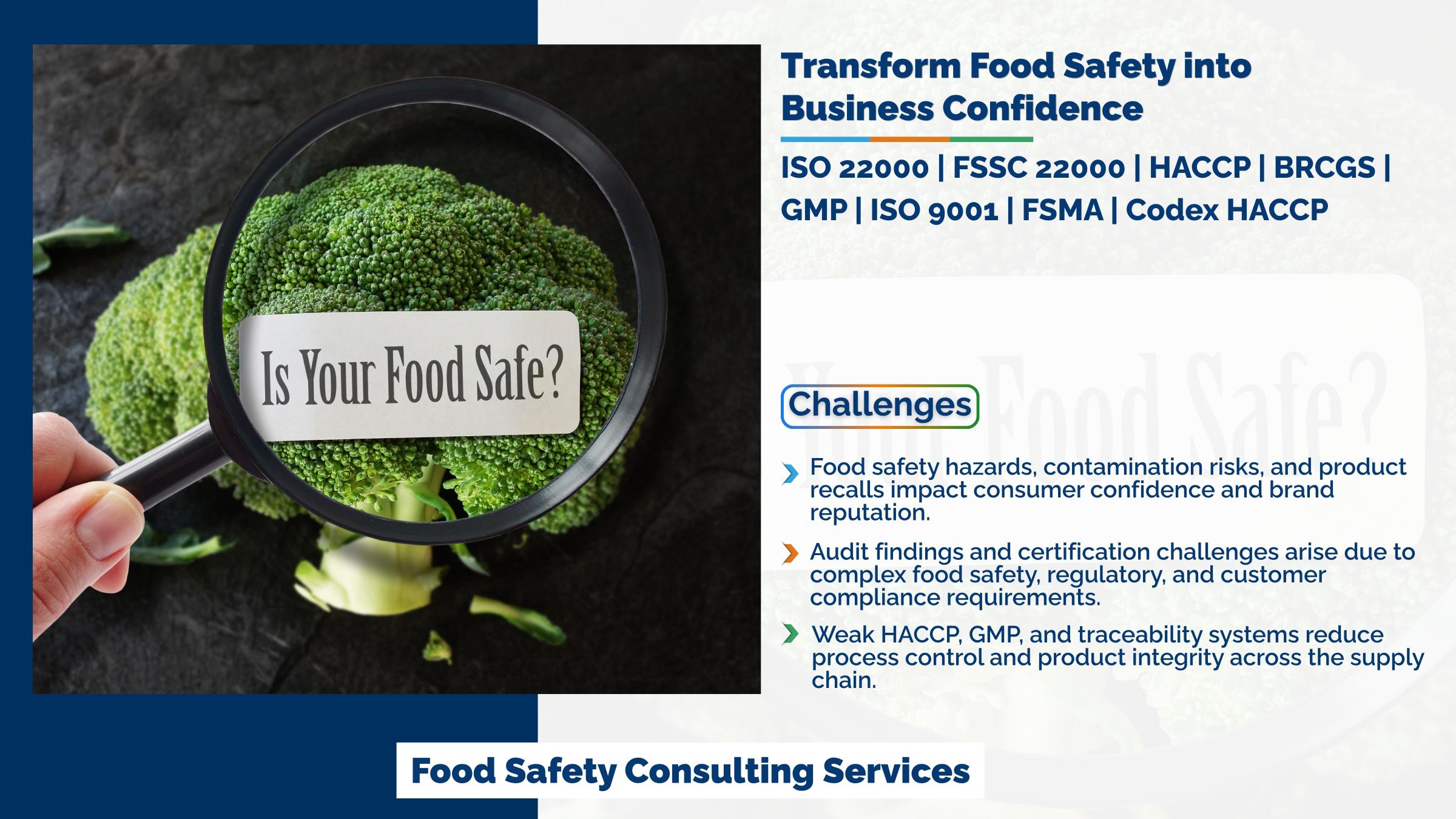
ISO 22000, HACCP, FSSC 22000, BRCGS, GMP & Food Safety Consulting Services
Transform Food Safety into Business Confidence
Food safety is fundamental to customer trust, regulatory compliance, operational excellence, and global market access. Food manufacturers, processors, exporters, retailers, hospitality businesses, and packaging companies must consistently deliver safe, high-quality products while complying with evolving national and international food safety requirements.
Smartedge Consulting helps organizations build robust Food Safety Management Systems (FSMS) that reduce business risks, improve operational performance, strengthen regulatory compliance, and enhance consumer confidence.
As an experienced ISO 22000 consulting company, Smartedge provides end-to-end Food Safety Management System (FSMS) consulting, HACCP implementation, FSSC 22000 consulting, BRCGS consulting, Food Safety Audits, GMP implementation, FSSAI compliance, Food Safety Training, and certification readiness services for the food and beverage industry.
Business Challenges We Help Solve
Food businesses today face increasing expectations from regulators, customers, retailers, and international markets. Product recalls, contamination risks, hygiene failures, inadequate traceability, supplier quality issues, and changing food safety regulations can significantly impact business performance and brand reputation.
Common challenges include:
- Food contamination and product safety risks
- Regulatory compliance with FSSAI and international food safety requirements
- HACCP implementation and hazard control
- Food hygiene and Good Manufacturing Practices (GMP)
- Supplier quality management and traceability
- Export market compliance and retailer requirements
- Packaging safety and food defense
- Limited internal food safety expertise
- Audit and certification readiness
- Customer and retailer compliance requirements
Smartedge helps organizations establish practical food safety systems that strengthen compliance, improve operational efficiency, minimize risks, and build long-term customer confidence.
How Food Safety Creates Business Value
An effective Food Safety Management System goes beyond certification. It creates structured processes for identifying hazards, managing risks, ensuring traceability, maintaining product quality, strengthening regulatory compliance, and driving continual improvement.
A well-designed food safety system enables organizations to:
- Protect consumer health
- Reduce food safety incidents
- Improve product quality and consistency
- Strengthen regulatory compliance
- Improve supplier performance
- Increase operational efficiency
- Support domestic and international market access
- Build customer confidence and brand reputation
- Reduce business risks and product recalls
- Drive sustainable business growth
Food safety becomes a competitive advantage rather than simply a regulatory obligation.
Our Food Safety & Compliance Services
ISO 22000:2018 – Food Safety Management System (FSMS)
Develop and implement internationally recognized Food Safety Management Systems that integrate HACCP principles, risk-based thinking, prerequisite programs (PRPs), and continual improvement.
Services include:
- ISO 22000 Gap Assessment
- FSMS Design & Implementation
- Documentation Development
- HACCP Integration
- Internal Auditor Training
- Internal Audits
- Management Review Support
- Certification Readiness
HACCP Implementation
Develop science-based hazard control systems that ensure food safety throughout the production process.
- Hazard Analysis
- Critical Control Point (CCP) Identification
- Risk Assessment
- HACCP Plan Development
- Validation & Verification
- Monitoring Systems
- Corrective Actions
- HACCP Training
FSSC 22000 Consulting
- FSSC 22000 Implementation
- PRP Development
- Additional FSSC Requirements
- Documentation
- Internal Audits
- Certification Support
BRCGS Food & Packaging Consulting
- BRCGS Food Safety
- BRCGS Packaging Materials
- Food Defense
- Food Fraud Prevention
- Traceability Systems
- Supplier Management
- Internal Audits
- Certification Readiness
GMP & Food Hygiene Consulting
- Good Manufacturing Practices (GMP)
- Good Hygiene Practices (GHP)
- Sanitation Programs
- Cleaning & Disinfection Systems
- Pest Management
- Personal Hygiene Programs
- Allergen Management
- Food Safety Culture
Regulatory & Export Compliance
- FSSAI Compliance
- Codex Alimentarius Alignment
- Food Safety Audits
- Supplier Audits
- Food Packaging Compliance
- Export Compliance
- Retailer Compliance Programs
Industries We Support
- Food Manufacturing
- Food Processing
- Dairy
- Meat & Poultry
- Seafood
- Beverage Industry
- Hotels & Hospitality
- Restaurants & Cloud Kitchens
- Food Packaging
- Warehousing & Distribution
- Agriculture & Fresh Produce
- Food Exporters
- Retail Food Chains
Business Outcomes You Can Expect
- Stronger food safety performance
- Improved regulatory compliance
- Better HACCP implementation
- Enhanced traceability and product control
- Reduced food safety incidents
- Increased operational efficiency
- Higher customer and retailer confidence
- Improved supplier quality management
- Successful certification readiness
- Better access to domestic and international markets
Why Smartedge
Smartedge Consulting combines food safety expertise with quality management, sustainability, operational excellence, supply chain improvement, energy management, and business performance consulting to deliver integrated solutions that create measurable business value.
Our multidisciplinary consulting approach enables organizations to strengthen food safety while improving operational performance, reducing risks, and supporting sustainable business growth.
Why Organizations Choose Smartedge
- ✔ Food Industry Expertise
- ✔ Practical Implementation
- ✔ Integrated Consulting
- ✔ Long-Term Partnership
Frequently Asked Questions
Do you provide ISO 22000 consulting?
Yes. Smartedge provides complete ISO 22000 consulting, including gap assessments, documentation, implementation, internal auditor training, internal audits, and certification readiness support.
Do you implement HACCP?
Yes. We help organizations develop and implement HACCP systems, conduct hazard analysis, identify Critical Control Points (CCPs), validate control measures, and train food safety teams.
Do you support FSSC 22000 and BRCGS certification?
Yes. We provide implementation, documentation, internal audits, training, and certification support for FSSC 22000 and BRCGS Food Safety and Packaging standards.
Can Smartedge help with FSSAI compliance?
Yes. We support organizations in strengthening food safety systems aligned with FSSAI requirements, Good Manufacturing Practices (GMP), Good Hygiene Practices (GHP), and internationally recognized food safety standards.
Ready to Build a Safer and More Competitive Food Business?
Whether you are implementing ISO 22000, HACCP, FSSC 22000, BRCGS, strengthening food safety systems, preparing for certification, or expanding into global markets, Smartedge Consulting helps you transform food safety into measurable business performance.
Protect consumers. Strengthen your brand. Expand with confidence.
Talk to Our Experts | Request a Proposal
ISO 22000:2018 – Food Safety Management System (FSMS)
Prevent food safety incidents, meet regulatory expectations, and build lasting consumer trust
The Industry Reality: Why Food Safety Can’t Be Left To Chance
In today’s competitive food industry, food safety is not just a compliance requirement—it is a brand responsibility. One incident can trigger product recalls, customer complaints, regulatory action, and long-term reputational damage. Food businesses must actively manage risks such as:
- Biological, chemical, and physical contamination
- Allergen cross-contact and mislabelling
- Poor hygiene and sanitation controls
- Supplier and raw material quality failures
- Storage, transport, and temperature abuse risks
To address these challenges systematically, global food markets rely on ISO 22000:2018, a recognized standard that strengthens food safety controls across the entire supply chain.
What Is ISO 22000:2018?
ISO 22000:2018 is the international standard for Food Safety Management Systems (FSMS). It sets requirements for any organization in the food chain to demonstrate its ability to:
- Identify food safety hazards
- Establish controls to prevent contamination
- Ensure food is safe for consumption
- Maintain and continually improve food safety performance
ISO 22000 is designed to work across the “farm to fork” chain and integrates smoothly with management system standards such as ISO 9001.
If your organization is pursuing ISO food safety certification in Hyderabad, Smartedge provides end- to-end consulting support to achieve certification confidently and efficiently.
Why Implement ISO 22000:2018?
ISO 22000 helps organizations build a structured, auditable system to control food safety hazards, aligned with:
- Legal and regulatory requirements
- Codex HACCP principles
- Customer and market expectations for safe, consistent food products
It moves food safety from ad-hoc checks to a system-driven approach with defined responsibilities, monitoring, corrective actions, and continuous improvement.
Key Benefits Of ISO 22000:2018
Implementing ISO 22000:2018 can deliver measurable business outcomes:
- Reduction in food safety incidents and related costs
- Compliance with legal requirements and Codex HACCP principles
- Lower liability risk and stronger recall preparedness
- Fewer errors, deviations, and customer complaints
- Continual improvement of products and processes
- Better resource optimization (internally and across suppliers)
- Sustainable and consistent food safety performance
- Improved confidence with consumers, suppliers, and regulators
- Stronger process control and management discipline
- Competitive advantage and improved market credibility
- Supports international trade and export readiness
- Improved overall organizational performance
Who Can Apply For ISO 22000 Certification?
ISO 22000 applies to all organizations involved in the food supply chain, regardless of size or role, including:
- Feed producers and primary producers
- Food manufacturers and processors
- Storage, transport, and distribution operators
- Warehousing and logistics providers
- Subcontractors and outsourced process units
- Retailers, caterers, hotels, restaurants, and food service outlets
It also applies to supporting sectors, such as:
- Food equipment manufacturers
- Packaging material suppliers
- Cleaning and sanitation chemical suppliers
- Ingredient, additive, and processing aid suppliers
In short: if you impact food safety anywhere in the chain, ISO 22000 is relevant.
Smartedge ISO 22000 Consulting Solutions (Hyderabad + Pan-India)
Smartedge supports organizations with complete ISO 22000 implementation and certification readiness:
- FSMS gap assessment and implementation roadmap
- Hazard analysis and control plan development (HACCP-aligned)
- PRPs / OPRPs / CCP identification and control design
- Documentation (manuals, SOPs, registers, records, formats)
- Supplier evaluation, traceability, and food defence readiness
- Training and awareness programs for staff
- Internal audits and management review support
- Certification body coordination and audit closure support
Smartedge Advantage
- Industry-practical implementation (not just documentation)
- Integration with ISO 9001 and IMS systems
- Audit-ready evidence building and closure support
- Strong focus on risk-based food safety controls across the value chain
In Summary
ISO 22000:2018 enables food businesses to prove control over hazards, strengthen compliance, and protect consumer trust—from raw materials to the final product. With Smartedge, you gain a structured, certification-ready FSMS that improves performance, reduces risk, and supports market growth.
FSSC 22000:2018 – Food Safety System Certification
GFSI-Recognised Food Safety Excellence for Global Market Access
The Industry Reality: Why Advanced Food Safety Certification Matters
As food supply chains become more complex and global, basic compliance is no longer enough. Food manufacturers, processors, retailers, and packaging suppliers face increasing pressure from:
- Global retailers and brand owners
- Export market regulations
- Customer audits and second-party assessments
- Heightened consumer awareness and recall risks
Organizations need a globally benchmarked, auditable, and trusted food safety system. This is where FSSC 22000 becomes critical.
What Is FSSC 22000:2018?
FSSC 22000 (Food Safety System Certification) is a globally recognized, GFSI-benchmarked certification scheme designed to ensure robust food safety management across the supply chain.
It is built on three pillars:
- ISO 22000 – Food Safety Management System
- Sector-specific Pre-Requisite Programs (PRPs)
- Additional FSSC-defined requirements
FSSC 22000 is fully recognized by the Global Food Safety Initiative (GFSI), making it widely accepted by international retailers, food brands, and buyers.
For organizations seeking ISO / FSSC food safety certification in Hyderabad, Smartedge provides expert consulting and end-to-end implementation support.
Why Implement FSSC 22000?
FSSC 22000 goes beyond basic FSMS compliance and demonstrates mature, internationally accepted food safety governance.
Organizations implement FSSC 22000 to:
- Control food safety hazards across complex operations
- Meet customer-specific and retailer requirements
- Comply with food laws and regulatory obligations
- Demonstrate supply-chain responsibility and traceability
- Achieve international acceptance and export readiness
Key Business Benefits Of FSSC 22000
Implementing FSSC 22000 delivers both risk reduction and business growth:
- Reduced food safety hazards and incident risks
- Stronger brand reputation and customer confidence
- Optimized processes and better resource utilization
- Lower costs through prevention and reduced rework
- Improved internal discipline and employee accountability
- Stronger trust across the food supply chain
- Easier access to international and high-value markets
- Ability to win new customers and partnerships
- Alignment with major retailers and global manufacturers
Why FSSC 22000 Is Preferred Globally
FSSC 22000 is chosen by food businesses because it:
- Safeguards food safety risks from internal and external threats
- Ensures compliance with applicable laws and regulations
- Meets stringent customer and retailer expectations
- Is accepted by food buyers worldwide
- Is GFSI-recognized, meeting the highest global food safety benchmarks
Who Should Implement FSSC 22000?
FSSC 22000 applies to a wide range of organizations across the entire food value chain.
Retail & Wholesale Sector
- Supermarkets and hypermarkets
- Convenience stores
- Wholesale (cash-and-carry) outlets
- Mass/club stores
- Food halls, bakeries, butcher shops
Catering & Food Services
- Airline, railway, cruise, and institutional catering
- Hospitals and healthcare facilities
- Schools and industrial canteens
- Restaurants, cafés, and food outlets
- Hotels, hospitality, and banqueting services
Transport & Storage
- Farm to processor logistics
- Processor to manufacturer transport
- Manufacturer to off-site warehouses
- Warehouse to retail or food service outlets
Food Manufacturing
- Dairy and cheese factories
- Slaughterhouses and meat processors
- Grain and cereal processing units
- Ready-to-eat food manufacturers
- Canned and long shelf-life food producers
Packaging & Packaging Materials
- Flexible and rigid plastics (films, sachets, crates)
- Paper and board (cartons, boxes, sacks)
- Metal (cans, containers)
- Glass (jars, bottles)
- Transport packaging (drums, tanks, big bags)
Animal Feed
Animal feed manufacturers play a critical role in the food chain and are fully covered under FSSC 22000.
Smartedge FSSC 22000 Consulting Services (Hyderabad & Pan-India)
Smartedge supports organizations with complete FSSC 22000 implementation and certification readiness, including:
- FSMS & FSSC gap assessment
- ISO 22000 + PRP integration
- Sector-specific PRP implementation (ISO/TS standards)
- Additional FSSC requirement compliance
- Documentation (manuals, SOPs, registers, records)
- HACCP, food defence, food fraud & allergen controls
- Training, internal audits, and management review
- Certification audit coordination and closure support
Smartedge Advantage
- Practical, audit-oriented implementation
- Strong experience across food, packaging, and logistics sectors
- Integration with ISO 9001 & IMS frameworks
- Faster certification with reduced non-conformities
In Summary
FSSC 22000:2018 is more than a certification—it is a passport to global food markets. With Smartedge Consulting, organizations build strong, compliant, and trusted food safety systems that protect consumers, satisfy buyers, and enable sustainable growth.
BRCGS Global Standard for Food Safety
Retailer-Driven Food Safety Assurance for Global Market Access
The Industry Reality: Retailers Demand Proven Food Safety
Global and European retailers operate under intense regulatory, consumer, and brand-risk pressure. A single food safety failure can result in product recalls, legal action, delisting by retailers, and irreversible brand damage.
To control these risks, leading retailers require suppliers to demonstrate robust, independently verified food safety systems. This is why BRCGS Food Safety certification has become a mandatory entry requirement for many supply chains.
What Is BRCGS?
BRCGS (Brand Reputation through Compliance – Global Standards) is the global standards body originally established by the British Retail Consortium.
BRCGS develops internationally recognised product safety and quality certification standards, used by suppliers in over 100 countries, and strongly adopted by:
- UK retailers
- European retailers
- Global brand owners and food processors
What Is BRCGS Global Standard for Food Safety?
The BRCGS Global Standard for Food Safety provides a structured framework to manage:
- Product safety
- Product integrity
- Legality
- Quality
- Operational food safety controls
It is specifically designed for food and food ingredient manufacturing, processing, and packing operations and is fully benchmarked to the Global Food Safety Initiative (GFSI).
Key Focus Areas of the BRCGS Food Safety Standard
The standard places strong emphasis on advanced food safety controls, including:
- Development and embedding of a food safety culture
- Expanded environmental monitoring requirements
- Strengthened food defence and site security systems
- Clear segregation and control of high-risk, high-care, and ambient high-care zones
- Specific clarity for pet food manufacturing
- Global applicability aligned with GFSI benchmarking
These requirements make BRCGS one of the most retailer-focused and operationally detailed food safety standards.
Why BRCGS Food Safety Certification Is Critical
Most UK retailers and many European and global brand owners only approve suppliers that are BRCGS-certified.
Organizations implement BRCGS to:
- Gain acceptance into retailer-driven supply chains
- Demonstrate due diligence and legal defence in food safety incidents
- Build a robust system for food safety, quality, and legal compliance
- Measure, monitor, and continually improve food safety performance
- Reduce risks of recalls, rework, waste, and customer complaints
Without BRCGS, access to many retail and export markets is significantly restricted.
Business Benefits of BRCGS Certification
BRCGS Food Safety delivers strong commercial and operational value:
- Increased market access across global retail supply chains
- Enhanced brand protection and reputation
- Reduced food safety, legal, and liability risks
- Demonstrated commitment to product safety and quality
- Reduced audit duplication through retailer acceptance
- Stronger and more mature food safety management systems
- Streamlined relationships with EU and UK retailers
- Improved operational efficiency: less waste, better organization, higher profitability
Who Should Implement BRCGS Food Safety?
BRCGS applies to organizations across the food value chain, including:
- Suppliers of retailer-branded and branded food products
- Food manufacturers and processors
- Ingredient manufacturers
- Catering and food-service suppliers
- Warehouses and pack houses
- Slaughterhouses and meat processors
- Canneries and preserved food units
- Handlers of high-risk ready-to-eat products
If your customers include retailers, brand owners, or international buyers, BRCGS is often non- negotiable.
Smartedge BRCGS Consulting Services (Hyderabad & Pan-India)
Smartedge supports organizations with end-to-end BRCGS Food Safety implementation and certification readiness, including:
- BRCGS gap assessment and compliance roadmap
- Food safety culture development
- HACCP and risk assessment aligned to BRCGS clauses
- High-risk and high-care zoning implementation
- Environmental monitoring program design
- Food defence and food fraud mitigation plans
- Documentation, SOPs, records, and evidence building
- Internal audits and management review
- Certification audit coordination and non-conformance closure
Smartedge Advantage
- Retail-audit-focused implementation approach
- Strong experience with high-risk and ready-to-eat operations
- Integration with ISO 22000 and FSSC 22000 where required
- Faster approvals with reduced major non-conformities
In Summary
BRCGS Global Standard for Food Safety is more than a certification—it is a retailer passport. With Smartedge Consulting, organizations achieve robust compliance, stronger buyer confidence, and sustainable access to global food markets.
BRCGS Global Standard for Packaging Materials
The Industry Reality: Packaging Is a Direct Food Safety Interface
Packaging is no longer a passive component—it is a critical food safety control point. Unsafe or poorly managed packaging can cause contamination, recalls, retailer rejections, and reputational damage. As a result, retailers and global brand owners require independently certified packaging suppliers.
What Is the BRCGS Global Standard for Packaging Materials?
The BRCGS Global Standard for Packaging Materials, developed by BRCGS, is a GFSI-recognised certification scheme designed to ensure that packaging materials are:
- Safe and hygienic
- Legally compliant
- Fit for their intended use
- Consistently manufactured under controlled conditions
The standard applies to organizations manufacturing packaging materials used for food and other hygiene-sensitive products, and is widely accepted by UK, EU, and global retailers and brand owners.
Scope of the Standard
The BRCGS Packaging Materials Standard applies primarily to manufacturers of converted packaging materials, and also covers:
- Prior converting operations
- Packaging supplied from stock where repacking or additional processing occurs
- Consumer disposable goods that come into contact with food
- Materials intended for food preparation
If your product comes into contact with food or influences food safety, this standard is applicable.
Why Implement BRCGS Packaging Materials?
Organizations adopt BRCGS Packaging Materials to:
- Meet retailer and brand-owner approval requirements
- Reduce multiple customer audits
- Improve hygiene, contamination control, and traceability
- Strengthen supplier assurance across the food supply chain
- Support structured improvement at both large and small manufacturing sites
Business Benefits
Certification delivers strong commercial and operational value:
- Increased transparency and product traceability
- Improved hygiene and contamination prevention
- Higher customer confidence and satisfaction
- Improved supplier standards and process consistency
- Reduced product failures, complaints, and recalls
- Elimination of repeated customer audits
- Easier access to global food manufacturers and retailers
Who Should Implement BRCGS Packaging Materials?
The standard is applicable to a wide range of packaging and material manufacturers, including:
- Glass manufacturing and forming
- Paper making and paper conversion
- Metal forming
- Rigid plastics manufacturing
- Flexible plastics manufacturing
- Printing and labelling processes
- Chemical processes related to packaging
- Other packaging-related manufacturing activities
It applies to primary, secondary, and tertiary packaging, depending on product use and risk.
Smartedge BRCGS Packaging Materials Consulting Services
Smartedge supports organizations with end-to-end implementation and certification readiness, including:
- Gap assessment and compliance roadmap
- Packaging hazard and risk analysis
- GMP, hygiene, and contamination control systems
- Traceability, supplier approval, and material compliance
- Documentation (manuals, SOPs, records, registers)
- Internal audits and management review
- Certification audit support and non-conformance closure
Smartedge Advantage
- Strong experience in food and packaging sectors
- Practical, shop-floor-focused implementation
- Integration with ISO 9001, ISO 22000, and FSSC 22000
- Faster certification with fewer major findings
In Summary
The BRCGS Global Standard for Packaging Materials is the current and recognised benchmark for safe, hygienic, and compliant packaging in global food supply chains. With Smartedge Consulting, packaging manufacturers build audit-ready systems, retailer confidence, and long-term market access.