
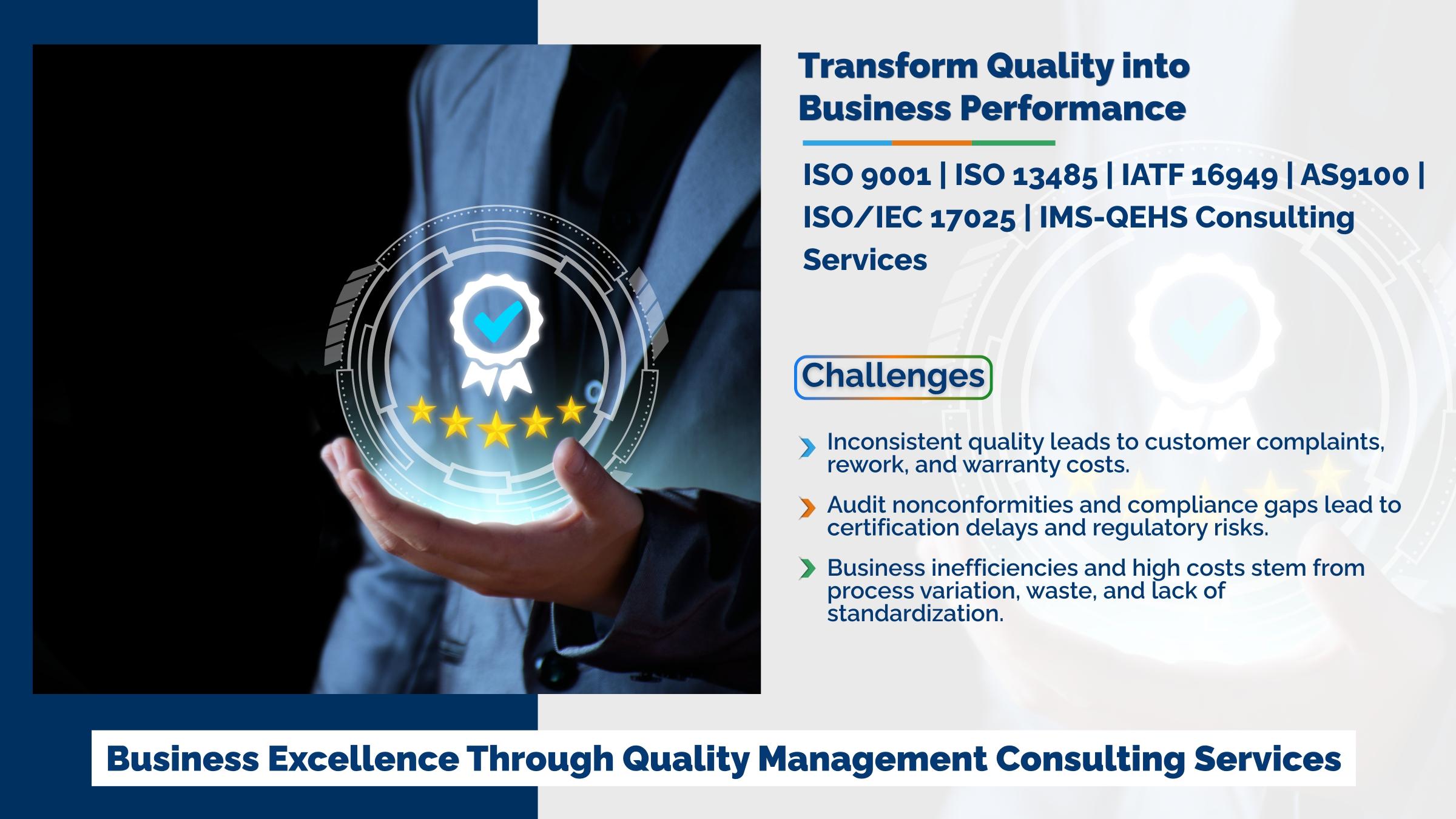
ISO 9001 | ISO 13485 | IATF 16949 | AS9100 | ISO/IEC 17025 | IMS-QEHS Consulting Services
Transform Quality into Business Performance
Quality is no longer just about achieving certification—it is about improving business performance, reducing operational risks, increasing customer satisfaction, and creating a culture of continual improvement.
Smartedge Consulting helps organizations design, implement, improve, and integrate Quality Management Systems (QMS) that deliver measurable business outcomes while meeting international standards, customer expectations, and regulatory requirements.
As an experienced ISO consulting company, we provide end-to-end Quality Management System (QMS) consulting, ISO implementation, Integrated Management System (IMS) consulting, internal auditor training, documentation support, gap assessments, and certification readiness services across multiple industries.
Whether your objective is ISO certification, operational excellence, regulatory compliance, or business transformation, Smartedge helps you convert quality into a strategic business advantage.
Business Challenges We Help Solve
Organizations today operate in an increasingly competitive and compliance-driven environment where customers expect consistent quality, regulators demand compliance, and markets require internationally recognized management systems.
Many organizations struggle with:
- Inconsistent product and service quality
- Recurring customer complaints and process variations
- Rising operational costs and resource inefficiencies
- Supplier quality and supply chain challenges
- Increasing statutory and regulatory compliance requirements
- Limited internal expertise for implementing Quality Management Systems
- Difficulty understanding process approach, risk-based thinking, and continual improvement
- Entering domestic and international markets requiring ISO certification
- Managing operational risks while maintaining business growth
Smartedge Consulting helps organizations overcome these challenges through practical Quality Management consulting solutions that improve operational performance, strengthen governance, optimize business processes, and build long-term organizational capability.
How Quality Drives Business Success
An effective Quality Management System provides a structured framework for managing business processes, people, resources, risks, and continual improvement.
Beyond certification, Quality Management enables organizations to:
- Improve operational efficiency and productivity
- Strengthen customer satisfaction and stakeholder confidence
- Reduce defects, rework, and operational costs
- Improve process consistency and standardization
- Manage business and operational risks effectively
- Strengthen supplier performance
- Meet statutory, regulatory, and customer requirements
- Support continual improvement and business excellence
- Build credibility in domestic and global markets
Quality Management becomes a foundation for sustainable business growth rather than simply a compliance requirement.
Our Quality Management Consulting Services
ISO 9001:2015 – Quality Management System
- Gap Assessment
- QMS Design & Documentation
- Process Mapping & Standardization
- Risk-Based Thinking Implementation
- Internal Auditor Training
- Employee Awareness Programs
- Management Review Facilitation
- Internal Audit Support
- Certification Readiness
- Continual Improvement Programs
Specialized Quality Management Systems
- ISO 13485 – Medical Device Quality Management Systems
- IATF 16949 – Automotive Quality Management Systems
- AS9100 – Aerospace & Defence Quality Management Systems
- ISO/IEC 17025 – Testing & Calibration Laboratory Management Systems
Integrated Management Systems (IMS-QEHS)
Integrating Quality, Environment & Occupational Health and Safety
Managing Quality, Environmental, and Occupational Health & Safety systems separately often results in duplicate documentation, inconsistent processes, higher audit costs, fragmented responsibilities, and increased compliance risks.
Smartedge Consulting helps organizations integrate:
- ISO 9001:2015 – Quality Management System
- ISO 14001:2015 – Environmental Management System
- ISO 45001:2018 – Occupational Health & Safety Management System
into one efficient Integrated Management System (IMS-QEHS) that improves operational performance, strengthens governance, reduces business risks, and supports sustainable growth.
Business Challenges We Help Solve
Organizations implementing multiple ISO standards commonly experience:
- Separate management systems with duplicated documentation
- Complex compliance and regulatory requirements
- Repeated internal and external audits
- Inconsistent business processes
- Poor coordination between Quality, Environment and Safety functions
- Customer complaints and process variability
- Increasing workplace incidents and environmental risks
- Lack of ownership and employee engagement
- Limited internal expertise for integrated ISO implementation
- Difficulty maintaining certification after implementation
Why Implement an Integrated Management System?
An Integrated Management System combines multiple ISO standards into one unified business management framework.
Instead of managing Quality, Environment, and Occupational Health & Safety independently, IMS creates one integrated system with:
- Common Policies
- Unified Business Processes
- Integrated Documentation
- Shared Objectives
- Common Internal Audits
- Single Management Reviews
- Unified Risk Management
- Simplified Compliance Management
- Organization-wide Continual Improvement
Resulting in:
- Lower operational costs
- Improved efficiency
- Stronger governance
- Easier certification management
- Better business performance
Standards Covered Under IMS
Core Standards
- ISO 9001 – Quality Management
- ISO 14001 – Environmental Management
- ISO 45001 – Occupational Health & Safety
Additional Standards That Can Be Integrated
ISO 50001, ISO 27001, ISO 22000, FSSC 22000, BRCGS, ISO 13485, ISO 15378, SA 8000
Industries We Support
- Pharmaceuticals & Life Sciences
- Food & Beverage
- Medical Devices
- Manufacturing
- Engineering
- Chemicals
- Automotive
- Infrastructure & Construction
- Healthcare
- Logistics & Warehousing
- IT & ITES
- Government & Public Sector
- Testing & Calibration Laboratories
Business Outcomes You Can Expect
Organizations implementing Smartedge solutions typically achieve:
- Improved operational efficiency
- Better product and service quality
- Higher customer satisfaction
- Stronger regulatory compliance
- Reduced operational and business risks
- Safer workplaces
- Improved environmental performance
- Better audit performance
- Reduced documentation duplication
- Greater employee competency
- Faster certification readiness
- Sustainable continual improvement
Why Smartedge Consulting?
Smartedge combines deep ISO expertise with practical business consulting experience to design management systems that create measurable business value—not simply certification.
Our multidisciplinary consultants integrate:
- Quality Management
- Safety
- Environment
- Sustainability
- Risk Management
- Operational Excellence
- Governance
into one unified management framework that supports long-term organizational success.
Why Organizations Choose Smartedge
- ✔ 20+ Years of Consulting Experience
- ✔ 500+ Successful Implementation Projects
- ✔ Practical Business-Focused Implementation
- ✔ Certified Lead Auditors & Industry Experts
- ✔ Integrated Consulting Across Quality, Safety, ESG & Risk
- ✔ End-to-End Support from Gap Assessment to Certification
- ✔ Onsite & Remote Consulting Across India
- ✔ Long-Term Partnership for Continual Improvement
Frequently Asked Questions (FAQ)
1. What is ISO 9001 and why is it important?
ISO 9001 is the world's most widely recognized Quality Management System (QMS) standard. It helps organizations consistently deliver quality products and services, improve customer satisfaction, manage risks, and drive continual improvement.
2. Does Smartedge provide ISO certification?
No. Smartedge Consulting is an independent consulting organization. We assist with gap assessments, documentation, implementation, training, internal audits, and certification readiness. Certification is conducted by accredited Certification Bodies.
3. Can Smartedge help organizations implementing ISO for the first time?
Yes. We provide end-to-end implementation support—from initial gap assessment and system design to employee training, internal audits, management review, and certification readiness.
4. Can multiple ISO standards be integrated into one management system?
Yes. We specialize in Integrated Management Systems (IMS) by combining standards such as ISO 9001, ISO 14001, ISO 45001, ISO 50001, ISO 27001, ISO 22000, and other applicable standards into a single, efficient management framework.
5. Which industries do you support?
Our consulting services support organizations across manufacturing, pharmaceuticals, medical devices, food processing, automotive, aerospace, engineering, chemicals, infrastructure, healthcare, logistics, IT & ITES, laboratories, government, and other service sectors.
6. What business benefits can organizations expect?
Organizations typically achieve improved operational efficiency, enhanced customer satisfaction, stronger regulatory compliance, better risk management, reduced process variation, improved audit performance, and sustainable continual improvement.
Ready to Transform Compliance into Business Performance?
Whether you are implementing your first Quality Management System, integrating multiple ISO standards, migrating to the latest ISO versions, or improving an existing management system, Smartedge Consulting provides practical, business-focused solutions that deliver measurable business results.
Talk to Our Experts
Request a Proposal | Book a Gap Assessment | Partner with Smartedge Consulting